
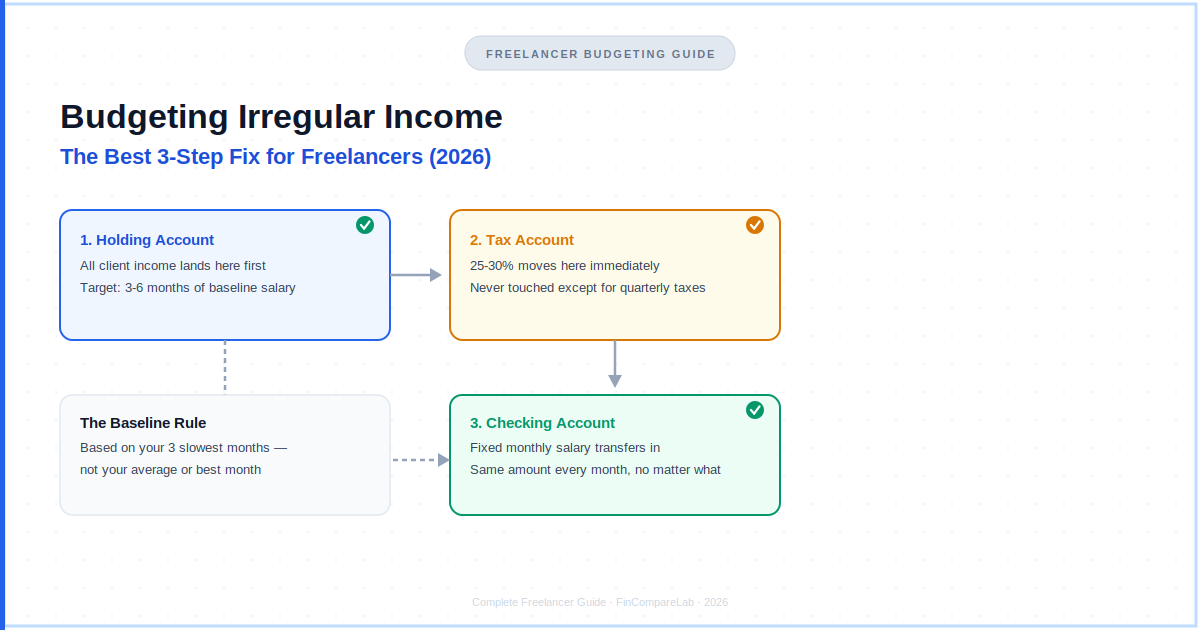
Budgeting irregular income is genuinely harder than budgeting on a salary. The advice you’ll find most places — save 20%, follow the 50/30/20 rule — assumes you know what’s coming in next month. When you’re a freelancer or contractor, you don’t.
⚡ Quick Answer
To budget on irregular income, you need three accounts — a holding account where all income lands, a tax account, and your regular checking account. Pay yourself a fixed monthly amount based on your slowest months. Let the holding account handle the ups and downs so your budget stays steady.
Setup time: about an afternoon. Works long-term for anyone dealing with irregular income.
Budgeting irregular income gets a lot less stressful once you have a system built for it, instead of one borrowed from salaried employees. It’s used by a lot of freelancers who got tired of feeling anxious every time work slowed down. It’s not complicated, but it does require some setup.
📋 What’s in this guide
- Why don’t standard budgets work for variable income?
- Step 1 — How do you calculate your baseline income?
- Step 2 — Work out your essential expenses
- Step 3 — How do you set up a holding account?
- Step 4 — Pay yourself a fixed monthly salary
- Step 5 — What do you do when income is high?
- Step 6 — How do you handle a slow month?
- Step 7 — How do you set aside taxes as a freelancer?
- What are the best budgeting apps for freelancers?
- What do freelancers ask most about budgeting irregular income?
Why Don’t Standard Budgets Work for Variable Income?
Standard budgets fail on irregular income because they assume a fixed paycheck. Freelancers earning $6,500 in March and $1,800 in April face the same rent bill either month. The fix: separate when money arrives from when you spend it, using a baseline income and a holding account instead of your paycheck total.
Standard budgeting rules are built around a fixed income. The 50/30/20 rule, zero-based budgeting templates, monthly spending plans — they all assume the same amount comes in every month. That’s not how freelance income works.
You might earn $6,500 in March and $1,800 in April. Your rent doesn’t change between those months. Your grocery bill doesn’t change. But your income does — a lot.
There’s also the good-month problem — something almost everyone with irregular income runs into. When a big payment lands, it’s tempting to spend more. New equipment, a holiday, dining out more. It feels fine because you earned it.
But spending heavily in good months and not saving enough means a slow month later can cause real stress.
The fix is a system that separates when money arrives from when you spend it. Once those two things are decoupled, variable income stops being a problem and becomes just how things are.
Most budgeting advice for freelancers stops at “track your lowest month and use that as your baseline.” That’s a fine starting point, but it doesn’t say what to do with the money once it arrives. The three-account structure below is the missing piece.
Step 1 — How Do You Calculate Your Baseline Income?
If you’re searching for how to budget with irregular income, this is where it starts: your baseline is the most important number in the whole system. It’s not your average income and it’s not your best month. It’s a conservative number based on your three slowest months — averaged together — that reflects what you can actually count on when work is quiet.
Here’s how to find it:
- Look at your last 12 months of income
- Find your three slowest months
- Average those three months together
- That’s your baseline
Three months averaged — not just the single worst — gives you a realistic floor. One terrible month is sometimes just bad timing. Three slow months averaged out is a more honest picture of what a difficult period looks like for your business. This baseline number becomes the anchor for everything else once irregular income is part of your life.
Example — freelance designer, last 12 months
| January | $4,200 |
| February — slowest | $1,650 |
| March | $5,900 |
| April | $6,300 |
| May | $4,500 |
| June | $7,200 |
| July | $3,800 |
| August — 2nd slowest | $1,900 |
| September | $5,400 |
| October | $6,700 |
| November | $4,300 |
| December — 3rd slowest | $2,300 |
| Baseline (3-month average) | $1,950/month |
Average annual income was around $4,600/month. But this person’s budget is built around $1,950 — because that’s what slow months actually look like.
If you’re new to freelancing with less than 12 months of data, use your slowest month so far as your starting point. Update it every few months as you collect more history.
Use after-expenses income. Your baseline should reflect what actually lands in your personal account after paying for any software, tools, or contractors the work requires. Gross revenue isn’t the same as personal income.
Step 2 — Work Out Your Essential Expenses
You need two lists: what you have to pay every month no matter what, and what you can reduce if a slow month hits.
Essential expenses
- Rent or mortgage
- Utilities — electricity, water, internet, phone
- Groceries (food shopping, not restaurants)
- Health insurance
- Minimum debt payments
- Transport — car payment, insurance, or transit
- Software or tools you need to do your work
Flexible expenses
- Dining out and coffee shops
- Streaming and subscription services
- Clothing and personal shopping
- Gym membership
- Travel
- Extra debt payments above the minimum
Add up the essential list. That number is your monthly survival figure — the minimum you need to keep everything running. The essentials list matters even more once irregular income enters the picture, since that total can vary so much from month to month. You’ll need it in Step 6 when a slow month arrives.
If your essential expenses are higher than your baseline income, that’s a pricing or spending problem — not a budgeting one. No system fixes a structural shortfall. But for most freelancers, the baseline comfortably covers essentials with room left over.
Step 3 — How Do You Set Up a Holding Account?
The holding account is the core of this system. It’s built specifically to handle irregular income without falling apart the first time a payment is late. Everything else depends on it.
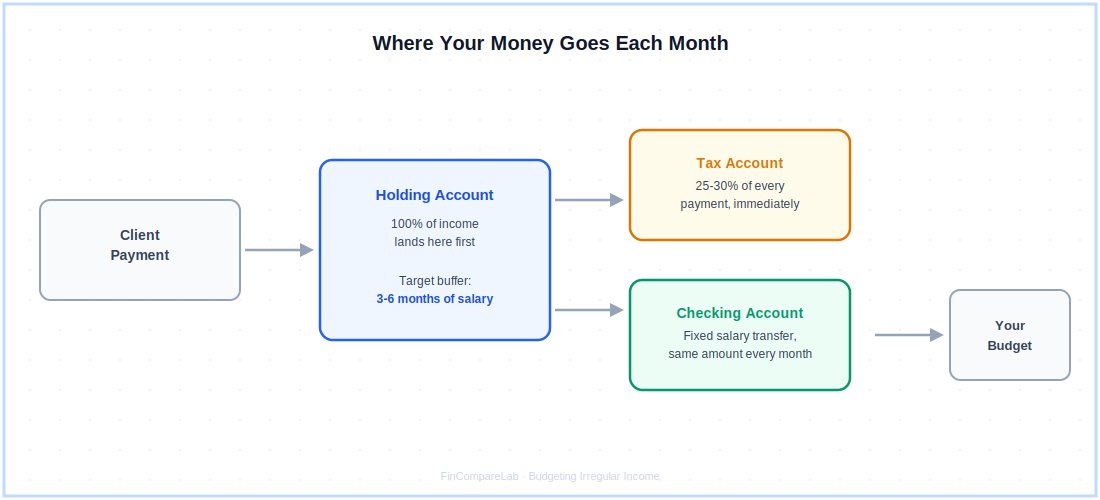
Right now, client payments probably go straight into your main account — the same one you use for groceries, bills, and everyday spending. That means your spending account goes up and down with your income. Flush one month, tight the next. The fix is to add a layer between your income and your spending.
Open a separate high-yield savings account. Direct every client payment there instead of your main account. This is your holding account — a reservoir that collects income and releases it at a steady, controlled rate.
Your main checking account gets a fixed transfer from the holding account every month. Same amount, on the same date, regardless of what came in that month.
Three-account setup
Holding account (high-yield savings): All income goes here. Target balance: 3–6 months of your baseline salary. Never spend directly from this account.
Tax account (separate savings): 25–30% of every payment moves here immediately. Only use it for quarterly tax payments.
Checking account: Your fixed monthly salary transfers here on the 1st. This is what you budget and spend from.
For the savings accounts, SoFi, Ally, Chime, and Marcus all offer high-yield accounts with no minimums. The bank matters less than keeping the accounts separate — this three-account structure is what makes a budget for irregular income hold up long-term instead of falling apart the first time a big client pays late.
Step 4 — Pay Yourself a Fixed Monthly Salary
On the 1st of every month, transfer a fixed amount from the holding account to your checking account. That’s your salary. Everything gets budgeted from that number — not from whatever came in this month.
This step is really the heart of managing irregular income day to day. Your salary should be your baseline income minus taxes.
| Baseline income | $1,950 |
| Tax reserve (28%) | − $546 |
| Monthly salary to yourself | $1,404 |
That number will feel low compared to what you earn in a good month. That’s okay.
The holding account absorbs the variation that comes with irregular income. In strong months it fills up. In slow months it covers the gap. Your checking account just sees the same amount every month.
After two or three months of running this system, most people notice the money anxiety around slow periods goes down. The income is still variable — but the stress isn’t, because the structure handles it.
Once the holding account buffer is comfortable — 3 months of salary sitting there — you can revisit the salary number and increase it if things are consistently going well.
YNAB works well with this system. YNAB only lets you budget money you already have — you never plan around income that hasn’t arrived. When your salary transfers in, you assign it to categories. It’s designed for exactly this kind of variable income situation. Read the YNAB review →
Step 5 — What Do You Do When Income Is High?
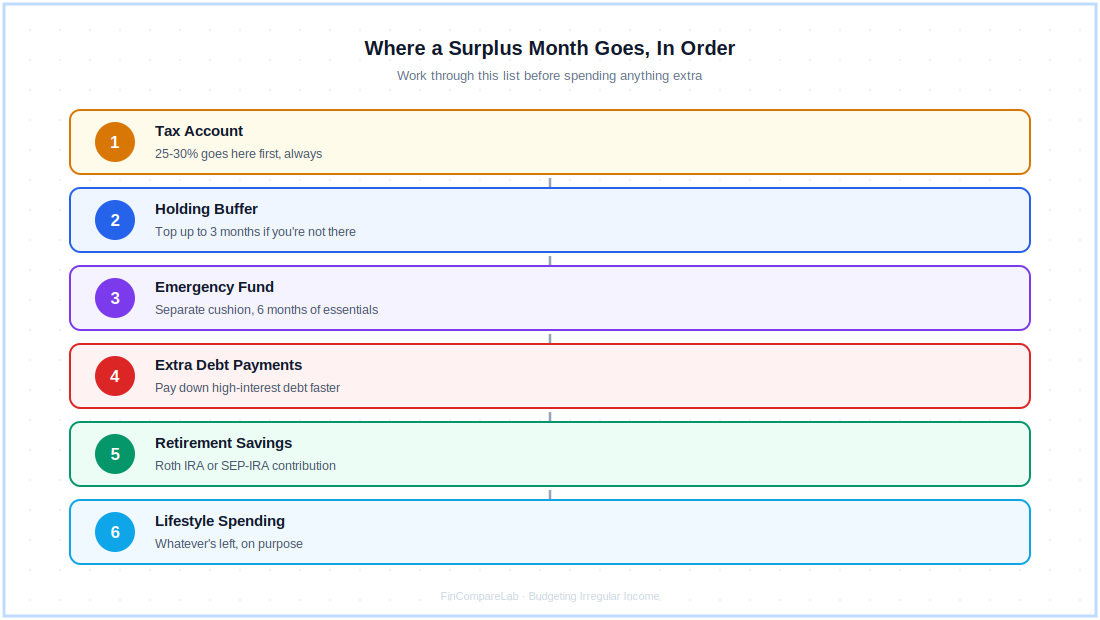
When a big month comes in — say $8,000 or $9,000 — it’s natural to want to spend more. High-earning months are common with irregular income, and the problem is that spending heavily in good months leaves nothing in reserve for slow ones. When surplus arrives, work through this list in order before spending anything extra:
- Tax account. 25–30% goes there the moment a payment lands. Always first, no exceptions.
- Holding account buffer. If you don’t have 3 months of salary saved there yet, put surplus here until you do.
- Emergency fund. Separate from the holding account. Aim for 6 months of essential expenses. This covers situations the holding account isn’t meant for — long illness, losing multiple clients at once.
- Extra debt payments. Good months are the right time to pay down high-interest debt faster. See the debt payoff guide for the fastest methods.
- Retirement savings. No employer is contributing to this for you. A Roth IRA or SEP-IRA contribution goes here.
- Lifestyle spending. Once everything above is covered, spending some surplus on something you want is fine. Decide on a specific amount rather than just spending whatever’s left.
It feels restrictive at first. After your first slow month passes without any financial stress, it starts to make a lot more sense.
Step 6 — How Do You Handle a Slow Month?
Even with the system running, slow months happen. A single rough month doesn’t have to derail everything once you’re used to irregular income. This is exactly the moment irregular income tests the system the most — here’s a straightforward approach when they do.
Check the holding account first
Your checking account will look normal — the same salary transferred as usual. The holding account tells you the real story. How many months of salary do you have in reserve? That number is your actual runway.
Check if income is delayed or actually missing
A lot of slow months are just late-paying clients. Before cutting spending, confirm whether work is actually slow or payments are just taking longer than usual. A client on 60-day terms isn’t the same as a dry pipeline.
For a short slow stretch
Pause flexible spending. Keep the normal salary transfer going — that’s what the buffer is there for. You don’t need to make any big changes.
For an extended slow period
If two or three months are quiet and the holding account is dropping, reduce the salary transfer to cover essentials only. Send more pitches, look for quicker work. Don’t touch the tax account under any circumstances.
What a well-handled slow month looks like: Income drops. The holding account covers your salary transfer anyway.
You pause dining out. You keep working. No crisis, no emergency decisions, no debt. That’s the goal of the system.
Step 7 — How Do You Set Aside Taxes as a Freelancer?
Taxes are one of the trickiest parts of managing irregular income, because no one withholds tax from freelance payments the way an employer would. Taxes catch a lot of people off guard for exactly this reason. If you don’t set it aside yourself, you’ll face a large bill — and penalties on top of it — when tax season arrives.
Move 25–30% of every payment to your tax account the moment it arrives. Before it has time to feel like spending money. Then pay quarterly estimated taxes to the IRS.
The deadlines are April 15, June 15, September 15, and January 15. Missing them when you owe more than $1,000 in annual tax results in underpayment penalties. Add all four to your calendar now.
Track business deductions as you go throughout the year — home office, software, equipment, health insurance premiums, professional development. These reduce your taxable income. It’s much easier to track them as they happen than to reconstruct everything later.
Quarterly tax deadlines: April 15 · June 15 · September 15 · January 15. Set calendar reminders for all four today.
What Are the Best Budgeting Apps for Freelancers?
Most budgeting apps are designed for people with a fixed salary. Not every app handles irregular income gracefully, which is why the comparison below matters. A good budget for irregular income has to flex without falling apart — here’s how the main options compare for freelancers specifically.
| App | Why it suits freelancers | Cost |
|---|---|---|
| YNAB | Only budget money you have. Works naturally with the holding account setup. Best for actively managing your monthly salary. | $109/yr |
| Goodbudget | Envelope method pairs well with a fixed salary. Manual entry keeps you conscious of spending. Solid free tier. | Free / $80/yr |
| Monarch Money | Good for tracking the bigger picture — holding account balance, net worth, income trends over time. Less suited to day-to-day budget management. | $99.99/yr |
| Google Sheets | Free and completely flexible. This free budget tracker in Google Sheets is a solid starting point — 7 tabs, dropdown categories, debt tracker and annual view. Many freelancers track the holding account in a spreadsheet and use YNAB for the monthly budget. | Free |
A good starting point: set up the three accounts first and build the buffer. Add YNAB once the structure is running. Once you know how to budget with irregular income using this system, picking an app is really just the finishing touch.
The system works without any paid app, but YNAB makes the monthly budget side a lot easier to manage. That’s really the whole approach to irregular income, laid out step by step.
→ Read the full YNAB review → · Compare all budgeting apps →
What Do Freelancers Ask Most About Budgeting Irregular Income?
These are the questions that come up most often once freelancers start setting up the three-account system — from how big the buffer should be to what happens if it runs dry. Anyone new to irregular income tends to ask the same handful of things first.
Is having an irregular income bad for your finances?
Not necessarily. Irregular income makes saving and budgeting harder, but it doesn’t have to hurt your finances long-term. The difficulty comes from mismatched timing — bills are fixed, income isn’t — not from the income itself. A structure like the one in this guide removes that mismatch.
How long does it take to get used to budgeting with irregular income?
Most people need about two to three months of running a system like this before it feels normal instead of stressful. That lines up with common advice across the personal finance space more broadly — freelancers who stick with a baseline-and-buffer approach for a full quarter tend to report it becoming automatic after that.
What’s the Best Budget for Irregular Income?
The best budget for irregular income is one built around a conservative baseline rather than your average or best month — paired with a holding account that absorbs the swings. A fixed monthly salary transfer from that holding account, plus a separate tax account, is what makes the whole thing stick long-term instead of falling apart the first time a slow month hits.
How to Budget With Irregular Income in One Sentence?
Calculate a conservative baseline from your three slowest months, route all income through a holding account, and pay yourself that baseline as a fixed salary every month regardless of what actually came in.
How much should I keep in the holding account?
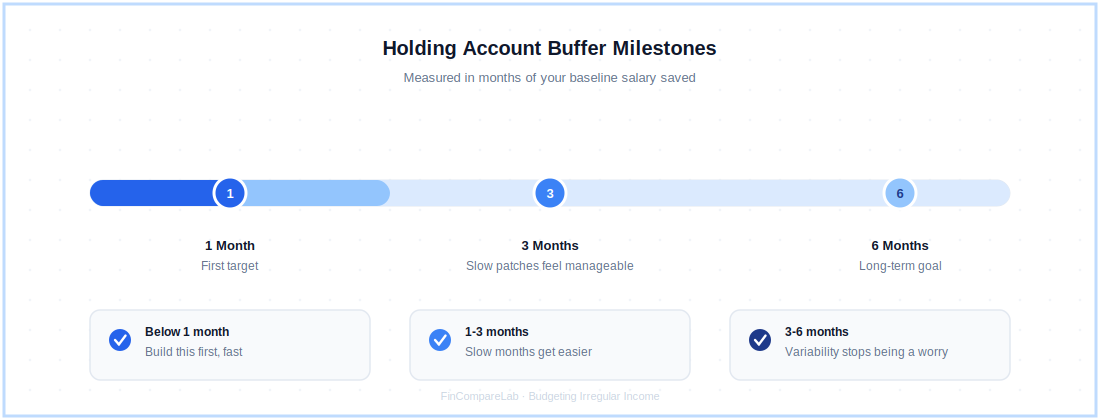
Start by targeting 1 month of your baseline salary. Move to 3 months as quickly as you can. At 3 months, slow patches feel manageable rather than stressful. 6 months is the long-term goal — at that point, income variability stops being something you worry about day to day.
What if I’m brand new to freelancing?
Use your lowest month so far as the baseline. If you’ve just started and don’t have much data, research typical slow periods in your field and use the low end of that range. Update the number every few months as you build more income history — this matters more with irregular income than with a steady paycheck.
Is YNAB useful for irregular income specifically?
Yes — it’s actually one of the better apps for this situation. YNAB only lets you budget money you already have, which means it naturally adjusts to variable earnings.
You don’t plan around income that hasn’t arrived. When the salary lands, you assign it. When nothing extra comes in, nothing extra gets assigned. See the YNAB beginners guide →
Should I pay myself weekly or monthly?
Monthly keeps things simpler — one transfer, one budget cycle, easier to track. Weekly works if monthly feels too difficult to manage. Either is fine. Most people find monthly cleaner.
Do I really need a separate account for taxes?
Yes. Keeping tax money in the holding account — even if you mentally earmark it — doesn’t work in practice, especially with irregular income where a slow month can tempt you to dip in. When a slow month hits, the temptation to use it is real.
A separate account with a separate login removes that option. It also makes it easy to know where you stand at any point in the year.
What if the holding account runs out?
Reduce the salary transfer to cover essentials only. Cut all flexible spending. Look for quick-turnaround work. Don’t touch the tax account.
If you have a separate emergency fund, that’s your next safety layer. The system is designed with multiple layers because this situation happens — it’s not a failure of the system, it’s what the layers are built for.
What’s the Setup Checklist?
Everything from this guide on budgeting irregular income in one list. Bookmark it — it’s the fastest way back on track if irregular income ever throws you off. Do these steps once, in order, and the system runs on its own after that.
- Pull 12 months of income data and calculate your baseline (3 slowest months averaged)
- List all essential expenses and calculate your survival number
- Open a high-yield savings account for the holding account
- Open a second savings account for taxes
- Redirect all income to the holding account
- Set up a fixed monthly transfer to your checking account (baseline minus taxes)
- Move 25–30% of every payment to the tax account immediately when it lands
- Set four quarterly tax deadline reminders in your calendar
- Build the holding account toward 3 months of buffer
- Choose a budgeting app to manage the monthly salary
📊 Free tool for freelancers: Once the three-account system is running, this free budget tracker in Google Sheets is a clean way to manage your monthly salary — track income, expenses by category, savings goals and debt in one place. Free forever, no account needed.
📚 Read Next
- YNAB Review 2026 — Best App for Variable Income Budgeting
- YNAB for Beginners 2026 — How to Set Up Your First Budget
- YNAB Pricing 2026 — Plans, Free Trial & Student Discount
- How to Get Out of Debt Fast 2026 — Step-by-Step Guide
- Best Budgeting Apps for Debt Payoff 2026
- Best Budgeting Apps for Beginners 2026
- Goodbudget Review 2026 — Best Free Envelope Option
This article is for informational purposes only and doesn’t constitute financial or tax advice. Tax rules vary — consult a tax professional for advice specific to your situation.
